Table of Content
U.S. Bank Stadium opened on July 22, 2016, with a two-day, public open house welcoming over 190,000 Minnesotans through its doors. The first event followed two weeks later on August 3, 2016 with the 2016 International Champions Cup pitting A.C. The first concert in the stadium featured Luke Bryan and was performed in front of a sold-out crowd on August 19, 2016, directly followed by a sold-out Metallica show on Saturday, August 20. The 2019 LCMS Youth Gathering took place July 11–15, 2019 at several downtown Minneapolis venues, including U.S. The 2021 ELCA Youth Gathering was scheduled to be held at the stadium from June 29–July 3 but due to COVID-19 it was postponed to July 24–28, 2022 before it was canceled altogether and moved to 2024 in New Orleans. The first NFL game at the stadium was the Week 3 preseason game against the San Diego Chargers on August 28, 2016.
To avoid parking near the stadium, Metro Transit offers light rail and bus service to and from Minneapolis. Fans can catch Blue or Green Line trains, and there are more than 123 interconnected bus routes throughout the Twin Cities. U.S. Bank Stadium, located at 401 Chicago Avenue in Minneapolis, does not directly manage any public parking areas. U.S. Bank Stadium was awarded the bid to become the first NFL stadium to host the NCAA DI Wrestling Championships in March 2020. In May 2012, the Minnesota Legislature and the Minneapolis City Council approved funding for the new $975 million multi-purpose stadium to replace the Metrodome.
Final Thoughts: Vikings Defense Faces Tough Task of Slowing Down Miami's Speed on Offense
The design team also planned to incorporate interactive technology into some elements to create a more engaging fan experience. On March 1, 2012, Governor Dayton announced an agreement for a new stadium to be built on the site of the Metrodome, pending approval by the state legislature and the Minneapolis city council. The $975 million project, half of which would be publicly funded, would be patterned after Lucas Oil Stadium.
"He played receiver before, so it's easier for him. You've got to do everything in your power for him not to get to that ball. When that ball is in the air, it's yours or nobody's." The Vikings did enough and pulled out an especially crazy overtime win over the Bills and have since turned their attention to this weekend's game against Dallas. "You can't say enough about [Za'Darius Smith] and Danielle , Patrick Jones and D.J. Wonnum, how they set those edges." O'Connell said defensive lineman Dalvin Tomlinson will miss a third consecutive game because of a calf injury he suffered against Arizona.
Uptick in revenue
In contrast, to be of any competitive on-field advantage to the Vikings, a retractable roof facility would have needed to be designed to operate in a Minnesotan winter so as to allow the Vikings to play a home game outdoors during the NFL playoffs. On May 10, 2012, the Minnesota Legislature approved funding for a new Vikings stadium on that site. The project is projected to have a $975 million price tag, with the Vikings covering $477 million, the state covering $348 million, and $150 million covered by a hospitality tax in Minneapolis. The city of Minneapolis must pay a total of $678 million over the 30-year life of the deal, including interest, operations, and construction costs. The bill was signed by Governor Dayton and received the approval of the Minneapolis City Council on May 25, 2012. The Vikings played in the Metrodome through the 2013 season, as construction did not require the dome's immediate demolition.

Stadiums represent a considerable expense to a community, and thus their construction, use, and funding often enters the public discourse. Also, given the perceived advantage a team gets from playing in their home stadium, particular attention is given in the media to the peculiarities of each stadium's environment. Weather, playing surface , and the presence or lack of a roof or dome all contribute to giving each team its home-field advantage. "They like to bring five-man pressures or align five guys on the line," Phillips continued. Stefon's younger brother plays cornerback for the Cowboys and was drafted 51st overall in 2020. Last season, Trevon racked up 11 interceptions and returned two of them for touchdowns.
Checklist for designing a reading nook or cozy corner
This total was a 95% reduction from what was estimated in the stadium bill passed in May 2012. U.S. Bank Stadium hosted the NCAA Men's Final Four in April of 2019 and welcomed a record-setting sporting event attendance of 72,711 guests. The event was a tremendous success and proved that Minneapolis should continue to be viewed as a destination for major events.

Under the leadership of Vikings COO Kevin Warren, the team moved to TCF Bank Stadium on the University of Minnesota campus until the new stadium was completed. After Hennepin County stopped their pursuit of a Vikings stadium, the city of Minneapolis submitted a plan for a Vikings' stadium at the downtown Metrodome site. The Minneapolis plan was for a fixed-roof stadium costing an estimated $895 million. The proposal also included funding solutions for $95 million in renovations to the Target Center.
As a result of the projected shortfall, members of the Minnesota Legislature and the Governor's office began discussing ideas to fix the shortfall. The legislature decided to impose an inventory tax on cigarettes to make up for any shortfall over the next year of construction and closing of a corporate income-tax loophole for the following years. In January 2014, a lawsuit was started by former Minneapolis mayoral candidate Doug Mann and two others to block the construction of the new stadium.
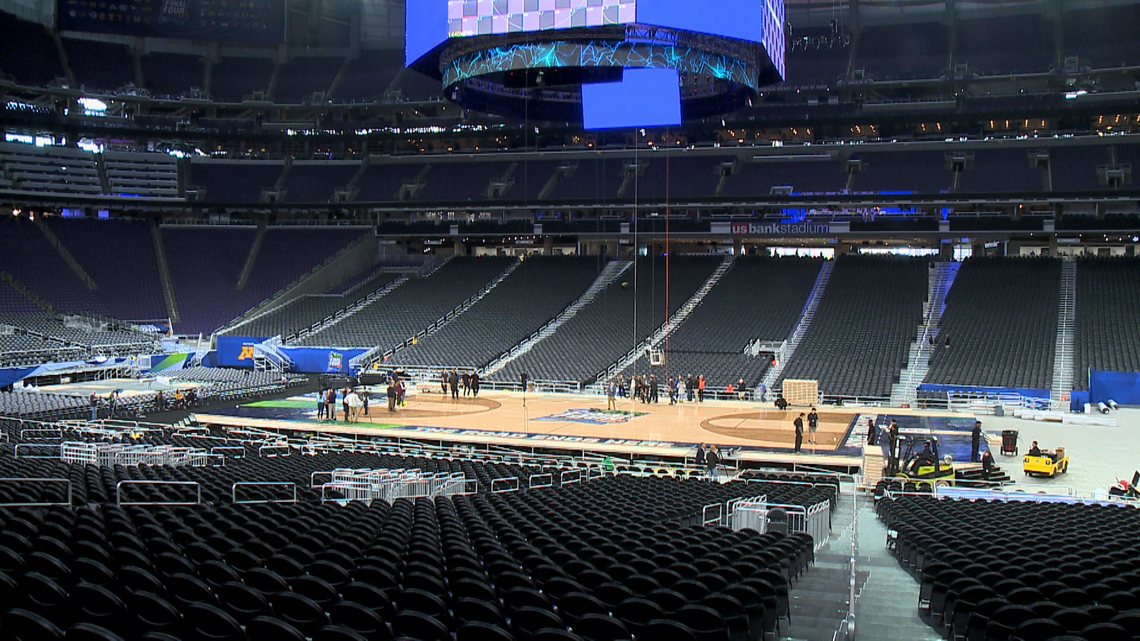
On April 19, 2007, the MSFC and the Vikings unveiled their initial plans for the stadium and surrounding urban area, with an estimated opening of 2012. The plan included substantial improvements to the surrounding area, including an improved light rail stop, 4,500 residential units, hotels with a combined 270 rooms, 1.7 million square feet of office space and substantial retail space. The seating capacity is 66,860 for most games, slightly more than the Metrodome, and can be expanded to 73,000 for soccer, concerts, and special events, such as the Super Bowl.
In May 2011, Ramsey County officials announced they had reached an agreement with the Minnesota Vikings to be the team's local partner for a new stadium, subject to approval by the Minnesota Legislature and to approval of a sales tax by the Ramsey County Board. The site of the stadium would be the former Twin Cities Army Ammunitions Plant in Arden Hills, which is about 10 miles from the Metrodome in Minneapolis and is a Superfund clean up site. The agreement called for an $884 million stadium and an additional $173 million for on-site infrastructure, parking and environmental costs. The translucent roof and large wall panels also give fans a view of downtown Minneapolis. The glass operable wall panels allow the stadium to experience some of the outdoor elements while providing protection from the snow, rain, and the cold winter weather.
As a result of the investigation, contractor Mortenson Construction and subcontractor Berwald Roofing faced fines of $173,400 for "serious" and "willful" safety violations. The reports do not provide an explanation of the accidents, but the largest fine, $70,000, and most serious alleged violation faults Berwald for willfully failing to have workers use proper fall protection while working at heights above 6 feet. While true for NFL football, for comparison, professional baseball and basketball gain no personal income for residents.
The stadium's first baseball game was between Century College and Iowa Central on February 24, 2017. The University of Minnesota was scheduled to play the first baseball game at the new stadium, but converting it from Supercross to baseball took stadium officials longer than projected. Minnesota ended up playing Seattle University later on that same day as the third game at the stadium, first indoor home game for the university since the Metrodome. U.S. Bank Stadium hosted its first playoff game, an NFC divisional game, on January 14, 2018, as the Vikings hosted the New Orleans Saints.
Vikings fans might remember Micah Parsons' first game against Minnesota on Halloween last year when he recorded career highs of 11 tackles and four tackles for loss. Jefferson and Diggs are familiar with one another after playing collegiately in the SEC for LSU and Alabama, respectively. But interestingly, according to analytics site Pro Football Focus, Jefferson has never been targeted when Diggs has been in coverage. When the Crimson Tide and Tigers played each other in 2019, Diggs allowed four catches for 88 yards and a touchdown to Ja'Marr Chase.



No comments:
Post a Comment