Table of Content
Vladimir Lenin was one of the most influential people in history who brought about significant change in his country that reverberated around the world and impacted the lives of millions. Though his thoughts on Marxism and capitalism are read to this day and influence many individuals and nations, his legacy will also be remembered for his brutal regime and the deaths of millions. Through violent means, he established a system of Marxist socialism called communism in the former Russian Empire, which attempted to impose collective control over the means of production, redistribute wealth, abolish the aristocracy, and create a more equitable society for the masses. Stalin, a close member of Lenin’s inner circle, became general secretary of the Communist Party in April 1922.
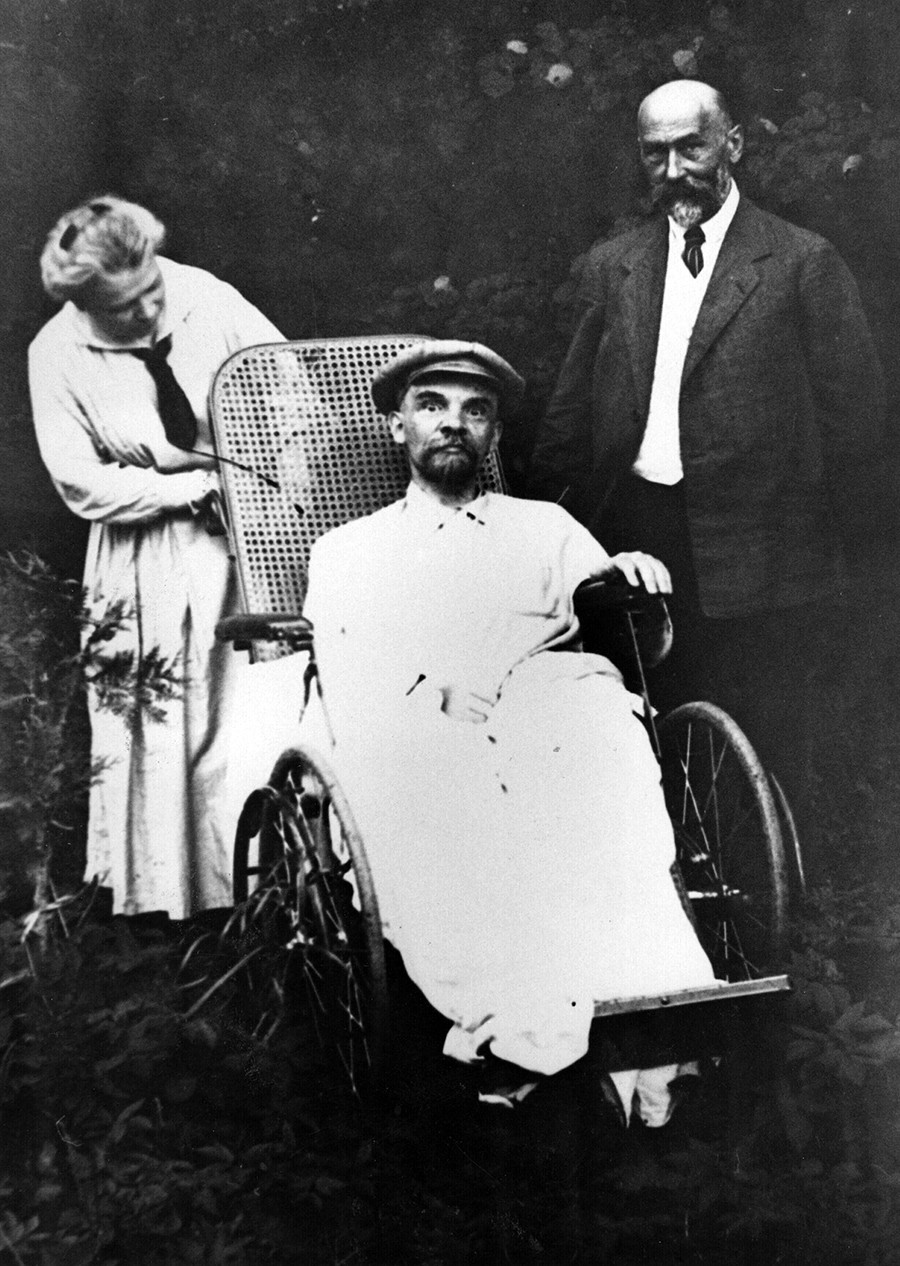
By May, he appeared to be making a slow recovery, regaining some of his mobility, speech, and writing skills. In his final weeks, Lenin was visited by Zinoviev, Kamenev, and Bukharin; the latter visited him at his Gorki mansion on the day of his death. His official cause of death was recorded as an incurable disease of the blood vessels.
READ NEXT
In April 1918, it nationalised foreign trade, establishing a state monopoly on imports and exports. In June 1918, it decreed nationalisation of public utilities, railways, engineering, textiles, metallurgy, and mining, although often these were state-owned in name only. Full-scale nationalisation did not take place until November 1920, when small-scale industrial enterprises were brought under state control. In September 1889, the Ulyanov family moved to the city of Samara, where Lenin joined Alexei Sklyarenko's socialist discussion circle.
After the 1917 February Revolution ousted the Tsar and established a Provisional Government, he returned to Russia to play a leading role in the October Revolution in which the Bolsheviks overthrew the new regime. There he also argued it would be possible to move immediately from feudalism to socialism and circumvent the capitalist stage of social and political development. This was a fundamental contradiction with Marx’s understanding of the proletarian class. Bernard-Henri Levy points out that in his critique of Hegel’s Philosophy of Law. Introduction, Marx clarified that the working class was not synonymous with the proletariat. Proletarian consciousness and the proletarian identity were forged through capitalist oppression and a concomitant awakening in the working class that would lead to the working class becoming the proletariat.
Censorship of Lenin's writings
In late 1917 Lenin led what was soon to be known as the October Revolution, but was essentially a coup d’état. The anti-Soviet forces headed mainly by former tsarist generals and admirals, fought desperately to overthrow Lenin’s Red regime. They were aided by World War I Allies, who supplied the group with money and troops.
Foreign powers such as France, Britain, the United States, and Japan also intervened in this war , though their impact was peripheral at best. Eventually, the more organizationally proficient Red Army, led by Leon Trotsky, won the civil war, defeating the White Army and their allies in 1920. In March 1919 Lenin and other Bolshevik leaders met with revolutionary socialists from around the world and formed the Communist International. Members of the Communist International, including Lenin and the Bolsheviks themselves, broke off from the broader socialist movement. In Russia, the Bolshevik Party was renamed the Russian Communist Party , which eventually became the CPSU. On April 16, 1917, Lenin arrived in Petrograd and took a leading role within the Bolshevik movement, publishing the April Theses, which called for an uncompromising opposition to the provisional government.
Studiul creierului lui Lenin[modificare | modificare sursă]
He was the posthumous source of "Leninism," the doctrine codified and conjoined with Marx's works by Lenin’s successors to form Marxism-Leninism, which became the Communist worldview. He has been regarded as the greatest revolutionary leader and thinker since Marx. Service described Lenin as "a bit of a snob in national, social and cultural terms".

What was meant to evolve into a society free from class distinction became a society that was dominated by the political apparatus created by a revolutionary vanguard that clung to its power with more violence than the previous political elite had. Influenced by Lenin, the Central Committee of the Bolshevik Party stated that the development of the socialist workers' culture should not be "hamstrung from above" and opposed the Proletkult (1917–1925) organisational control of the national culture. In the April Theses , the political strategy of the October Revolution (7–8 November 1917), Lenin proposed that the Russian revolution was not an isolated national event but a fundamentally international event—the first socialist revolution in the world. Once in power, Lenin withdrew Russia from WWI, but his Red Army ended up fighting a three-year civil war with the White Army, a coalition of monarchists, capitalists, and democratic socialists. To fund the war, Lenin instituted something called “War Communism,” which nationalized all manufacturing and industry and requisitioned grain from farmers to feed the troops and sell abroad to raise cash for the government.
Britannica is the ultimate student resource for key school subjects like history, government, literature, and more. The Constituent Assembly was declared dissolved by the Bolshevik-Left SR Soviet government, rendering the end the term served. Various historians and biographers have characterised Lenin's administration as totalitarian, and as a police state, and many have described it as a one-party dictatorship. Several such scholars have described Lenin as a dictator; Ryan stated that he was "not a dictator in the sense that all his recommendations were accepted and implemented", for many of his colleagues disagreed with him on various issues. Fischer noted that while "Lenin was a dictator, not the kind of dictator Stalin later became." Volkogonov believed that whereas Lenin established a "dictatorship of the Party", it would only be under Stalin that the Soviet Union became the "dictatorship of one man." In March 1923, Lenin had a third stroke and lost his ability to speak; that month, he experienced partial paralysis on his right side and began exhibiting sensory aphasia.
Fearing a counter-revolution from right-wing forces hostile to socialism, the Mensheviks and Socialist-Revolutionaries who dominated the Petrograd Soviet had been instrumental in pressurising the government to normalise relations with the Bolsheviks. Both the Mensheviks and Socialist-Revolutionaries had lost much popular support because of their affiliation with the Provisional Government and its unpopular continuation of the war. The Bolsheviks capitalised on this, and soon the pro-Bolshevik Marxist Trotsky was elected leader of the Petrograd Soviet.
On arrival, Lenin delivered a speech at Finland Station that became the basis for his famous April Theses. It called for an immediate socialist revolution, for a transfer of political power to the Soviets and an end to co-operation with the Provisional Government. A police mugshot of Vladimir Ulyanov, after his arrest in 1895Entering adulthood, Ulyanov became obsessive about socialism and revolution.
Lenin also developed the theory of Imperialism that proposed spreading Communism in the developing world to encircle the West. He taught that it was possible to establish a communist state in an agrarian economy without going through the stage of capitalism under the bourgeois rule. The extent to which Lenin was both the philosophical and the structural architect of the Soviet system is evidenced by the fact that the ideology of the state is often termed Marxism-Leninism. The Bolshevik government nationalised industry and established a foreign-trade monopoly to allow the productive coordination of the national economy and so prevent Russian national industries from competing against each other. To feed the populaces of town and country, Lenin instituted war communism (1918–1921) as a necessary condition—adequate supplies of food and weapons—for fighting the Russian Civil War. In March 1921, the New Economic Policy (NEP, 1921–1929) allowed limited local capitalism and replaced grain requisitions with an agricultural tax managed by state banks.
He first adopted the pseudonym Lenin in December 1901, possibly based on the Siberian River Lena; he often used the fuller pseudonym of N. Lenin, and while the N did not stand for anything, a popular misconception later arose that it represented Nikolai. Under this pseudonym, he published the political pamphlet What Is to Be Done?

Stalin had suggested that both Georgia and neighbouring countries like Azerbaijan and Armenia should be merged into the Russian state, despite the protestations of their national governments. Lenin saw this as an expression of Great Russian ethnic chauvinism by Stalin and his supporters, instead calling for these nation-states to join Russia as semi-independent parts of a greater union, which he suggested be called the Union of Soviet Republics of Europe and Asia. After some resistance to the proposal, Stalin eventually accepted it but, with Lenin's agreement, he changed the name of the newly proposed state to the Union of Soviet Socialist Republics . Lenin sent Trotsky to speak on his behalf at a Central Committee plenum in December, where the plans for the USSR were sanctioned; these plans were then ratified on 30 December by the Congress of Soviets, resulting in the formation of the Soviet Union. Despite his poor health, Lenin was elected chairman of the new government of the Soviet Union.




No comments:
Post a Comment