Table of Content
By the second half of 1921, Vladimir Lenin’s health became a significant issue. The Politburo insisted that he take time off, and in July 1921, Lenin left Moscow to spend time in his house in Gorki, where he was attended to by his wife and a host of physicians. Despite the attention, doctors were unable to determine the cause of his suffering. During this time, Lenin still remained a powerful figure, influencing the governance of the state. The Russian economy was in poor shape, and to address this problem, Lenin implemented the New Economic Policy , which allowed for limited capitalist practices. Under this policy, small private enterprise was permitted, along with property ownership of small industries.

Further fueling these sentiments was the move away from relations with western powers, as many did not recognize the new Russian government. In addition to this, Vladimir Lenin made the decision to nationalize all foreign property. To that end followed proposals reducing the administrative powers of party posts to reduce bureaucratic influence upon the policies of the Communist Party. Lenin advised Trotsky to emphasise Stalin's recent bureaucratic alignment in such matters (e.g. undermining the anti-bureaucratic workers' and peasants' Inspection) and argued to depose Stalin as General Secretary.
Șeful statului sovietic[modificare | modificare sursă]
Meanwhile, at a Paris meeting in June 1911, the RSDLP Central Committee decided to move their focus of operations back to Russia, ordering the closure of the Bolshevik Centre and its newspaper, Proletari. Seeking to rebuild his influence in the party, Lenin arranged for a party conference to be held in Prague in January 1912, and although 16 of the 18 attendants were Bolsheviks, he was heavily criticised for his factionalist tendencies and failed to boost his status within the party. Although he briefly supported the idea of reconciliation between Bolsheviks and Mensheviks, Lenin's advocacy of violence and robbery was condemned by the Mensheviks at the Fourth RSDLP Congress, held in Stockholm in April 1906. Lenin was involved in setting up a Bolshevik Centre in Kuokkala, Grand Duchy of Finland, which was at the time a semi-autonomous part of the Russian Empire, before the Bolsheviks regained dominance of the RSDLP at its Fifth Congress, held in London in May 1907. As the Tsarist government cracked down on opposition, both by disbanding Russia's legislative assembly, the Second Duma, and by ordering its secret police, the Okhrana, to arrest revolutionaries, Lenin fled Finland for Switzerland. There, he tried to exchange those banknotes stolen in Tiflis that had identifiable serial numbers on them.

Born in Simbirsk, Russian Empire , Lenin was the son of Ilya Nikolaevich Ulyanov (1831–1886), a Russian civil service official who worked for progressive democracy and free universal education in Russia, and his wife Maria Alexandrovna Ulyanova (1835–1916). The two raised their children in the spirit of denial of autocracy and religion. All of their children, except early deceased Olga, became professional revolutionaries. Although the family was of mixed ethnic ancestry, "Lenin's antecedents were Russian, Kalmyk, Jewish, German and Swedish, and possibly others," Lenin was baptized into the Russian Orthodox Church. From even before the civil war, and indeed the Revolution itself, there were components of Russian society that were seen as threats to the success of Bolshevism within the country. Various enemies were identified, along with methods constructed to root out and eliminate these threats.
Vladimir Lenin Quotes
During his reign, he acquired vast amounts of land through ruthless means, creating a centrally controlled government. He left Samara in the mid-1890s for a new life in St. Petersburg, the Russian capital at the time. There, Lenin connected with other like-minded Marxists and began to take an increasingly active role in their activities. Widely considered one of the most influential and controversial political figures of the 20th century, Vladimir Lenin engineered the Bolshevik revolution in Russia in 1917 and later took over as the first leader of the newly formed Union of Soviet Socialist Republics . Vladimir Lenin founded the Russian Communist Party, led the Bolshevik Revolution and was the architect of the Soviet state.
The two groups had sparred since party’s Second Congress, which had handed Lenin’s group, known as the Bolsheviks, a slim majority. The fighting would continue until a 1912 party conference in Prague, when Lenin formally split to create a new, separate entity. Lenin, aware of the leadership vacuum plaguing Russia, decided to seize power. He secretly organized factory workers, peasants, soldiers and sailors into Red Guards—a volunteer paramilitary force. On November 7 and 8, 1917, Red Guards captured Provisional Government buildings in a bloodless coup d’état. In Russia in 2012, a proposal from a deputy belonging to the Liberal Democratic Party of Russia, with the support of some members of the governing United Russia party, proposed the removal of all Lenin monuments.
Vladimir Lenin summary
To deal with the dissent, at the Tenth Party Congress in February 1921, Lenin introduced a ban on factional activity within the party, under pain of expulsion. By early 1918, many cities in western Russia faced famine as a result of chronic food shortages. Lenin blamed this on the kulaks, or wealthier peasants, who allegedly hoarded the grain that they had produced to increase its financial value. In May 1918, he issued a requisitioning order that established armed detachments to confiscate grain from kulaks for distribution in the cities, and in June called for the formation of Committees of Poor Peasants to aid in requisitioning. This policy resulted in vast social disorder and violence, as armed detachments often clashed with peasant groups, helping to set the stage for the civil war.
Their humble origins furnished the Ulyanovs with empathy with Russia’s peasant and working classes. In her memoirs, Lenin’s sister recalled the family home being filled with passionate discussion and debates about the situation in Russia. According to British historian Orlando Figes, Lenin had always been an advocate of "mass terror against enemies of the revolution" and was open about his view that the proletarian state was a system of organized violence against the capitalist establishment. Figes also claims that the terror, while encouraged by the Bolsheviks, had its roots in the common anger against the privileged. When in late 1918 Kamenev and Bukharin tried to curb the "excesses" of the Cheka, it was Lenin who defended it. In 1922, on his instigation, some eight thousand priests and laymen were executed, following an uprising by the clergy in the textile town of Shuia.
Where was Vladimir Lenin born?
When Mikhail Gorbachev took power in 1985 and introduced the policies of glasnost and perestroika, he too cited these actions as a return to Lenin's principles. Yeltsin did not dismantle the Lenin mausoleum, recognising that Lenin was too popular and well respected among the Russian populace for this to be viable. In the Soviet Union, a cult of personality devoted to Lenin began to develop during his lifetime, but was only fully established after his death. According to historian Nina Tumarkin, it represented the world's "most elaborate cult of a revolutionary leader" since that of George Washington in the United States, and has been repeatedly described as "quasi-religious" in nature.
He read voraciously, consuming books about philosophy and socialist theory, political propaganda, reports from or about revolutionary groups around the world. When not reading, Ulyanov was writing or speaking in workers’ circles or at underground meetings. Lenin's health had already been severely damaged by the strains of revolution and war. The assassination attempt earlier in his life also added to his health problems.
There, he began raising funds for a newspaper, Iskra , a new organ of the Russian Marxist party, now calling itself the Russian Social Democratic Labour Party . In July 1900, Lenin left Russia for Western Europe; in Switzerland he met other Russian Marxists, and at a Corsier conference they agreed to launch the paper from Munich, where Lenin relocated in September. Containing contributions from prominent European Marxists, Iskra was smuggled into Russia, becoming the country's most successful underground publication for 50 years.
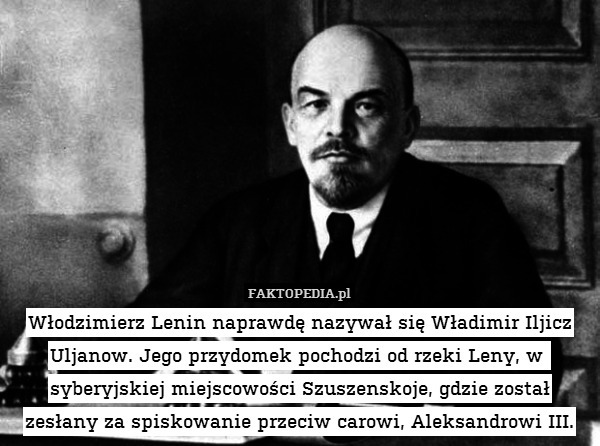
The bullet was still lodged in his neck, too close to his spine for medical techniques of the time to remove. He was left partially paralyzed on his right side, and his role in government declined. After the second stroke in December of the same year, he resigned from active politics. In March 1923 he suffered his third stroke and was left bedridden for the remainder of his life, no longer able to speak.
Though numerous attempts at readmission failed, he later enrolled as an external student at St. Petersburg University. Lenin completed his education there in 1891 and then briefly labored as a defense attorney. By that time, he had become enthralled by the work of famed communist thinker Karl Marx.




No comments:
Post a Comment